 You’ve got to hand it to academics; they have a way of expressing the most basic concept in the most baroque way.
Take a recent study out of Brigham Young University. It looks at what happens when grandparents who don’t live with their grandkids are close to them, either emotionally or financially, or both. (In this study, the kids are between the ages of 10 and 14.) This closeness is called affectual solidarity. And, as we old farts could have predicted, the kids who are close to their grandparents are better off than the kids who are not. The lucky kids have what is called lower levels of emotional distress and higher levels of pro-social behavior: i.e. they are happier and they do better in school.
“This high quality emotional tie is an important microsystem influence.” Well, sure it is. By the way, this microsystem influence is important regardless of income, but seems to have more of an impact in single parent households. Uh huh. The beleaguered single parent is more likely to be stretched thin.
So here is yet another reason to keep your grandparent skills sharp and available when you are thinking about the good that you can do as you move towards, or settle firmly, into, your years of decline.
Of course, further study is needed.
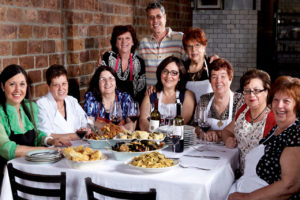 Jody Scaravella grew up in a close-knit Brooklyn-Italian family. When several relatives died within a short period, he felt unmoored. So he moved to Staten Island. Soon, a storefront near the ferry spoke to him. “Restaurant,” it whispered; “Italian family restaurant.”
 nice to have a study from Brigham Young University that lays it all out. For fifth graders who had grandparents living near by, those who were close to them had improved social skills, like kindness and compassion, and were more engaged in school. Grandparents who helped their offspring financially, especially single parent families, were able to make a real difference in their grandchildren’s lives.
 This just in from an Australian study reported in the journal Menopause: Since everyone knows that keeping mentally alert and socially engaged are plus factors in staving off dementia, a team of scientists decided to look at whether or not caring for grandchildren made a difference in the health of post-menopausal women. After all, they reasoned, that caretaking was something that lots of p.m. women do. Why not factor it in?
 You have probably heard about the threat to African elephants: 17,000 slaughtered in 2011. And grandmothers are at the center of this crisis.
 In 2004, 13 indigenous grandmothers heard the cry of Mother
 Don’t you just hate that phrase: it’s so simple, even my grandmother can understand it?
 A 20-something Australian journalist decided to spend a week eating the way her grandmother did in 1964: eggs and bacon for breakfast, white bread and baked beans for lunch; and, for dinner, meat, three veg (one always potato) and dessert.