 Want to watch a new grandmother splutter and try to retain her self-control? Just ask her about safety. Sure, we know that the goal is to prevent injury and save lives, but sheesh! don’t these people know when to lighten up?
These people would refer to the parents; the adults who are setting the rules and establishing the standards of proper behavior — standards that the new grandmother must follow, or at least pretend to, when the parents are in sight and/or the little ones are old enough to snitch.
But there is still a good possibility that you, as the grandparent, will go along with rules. After all, 1) It is not your child. 2) You don’t want to run the risk of alienating your actual child (the parent in the situation. 3) What if your luck runs out and the baby/child injures itself on your watch, and you have to admit that YOU WERE NOT FOLLOWING THE RULES? You, who, in the faraway past, tore your hair out getting those very people to understand the concepts of risk, prevention, thinking ahead, etc. etc. etc.
The problem is that standards have leapt up several notches. There is so much more consciousness of the possibility of injury, such an explosion of specialized products, so much more child-centeredness.
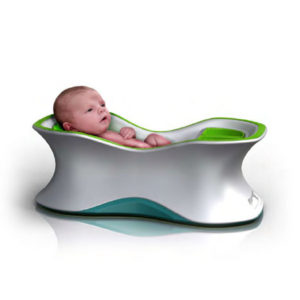
In my first days as a grandmother, I resisted the baby bathtub. After all, the kitchen sink had worked perfectly well for my kids and, I assume, for babies back to the dawn of history. (All right; maybe they didn’t even have kitchen sinks at the dawn of history.)
But when I suggested that kitchen sink possibility to the new parents, you would have thought I was advocating…..oh, let’s not go there. So, at the baby’s house, I dutifully used the baby gizmo. By the time the baby came to visit me, I even bought one for my own kitchen.
Did I learn to love it? No. Every time I used it, I had the same mental conversation: Ok; I see how this would make you feel better if you were anxious. Is there something wrong with me that I had not been sufficiently worried about bathing my own newborn in the same stainless steel sink where I had washed onions, and which I cleaned out with products that were probably poisonous? Or did I now, with my failing mental powers, just not remember?
Even in the form-fitting cozy plastic tub, my grandchild baby was able to squirm and cry and generally act uncooperative at times, although at other times, said baby was a model of infant delight, enjoying the gentle pat-down with the soft, tiny baby washcloth and the premium baby soap. I enjoyed knowing that I was doing the right thing; that my children and my children’s spouses would not be branding me as truculent or worse.
I had passed the first test of grandmotherhood: maintaining family peace.
 When Mary LaCava’s first grandchild went off to college, she tucked a twenty dollar bill into an envelope and, using old hotel stationery, sent it off with a short note. “I figured she could use it,” she recalled. She continued the practice every week.
 As parents, we try so hard not to play favorites. Or, if we do, we do our best to hide our little indiscretions. But even when we are being fair, sometimes our kids will still complain that the other person is getting the piece of cake that has the most frosting, or is somehow getting the bigger slice of the pie.
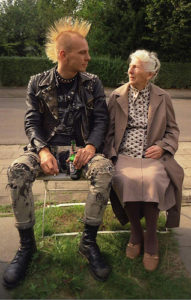 You’ve got to hand it to academics; they have a way of expressing the most basic concept in the most baroque way.
 nice to have a study from Brigham Young University that lays it all out. For fifth graders who had grandparents living near by, those who were close to them had improved social skills, like kindness and compassion, and were more engaged in school. Grandparents who helped their offspring financially, especially single parent families, were able to make a real difference in their grandchildren’s lives.
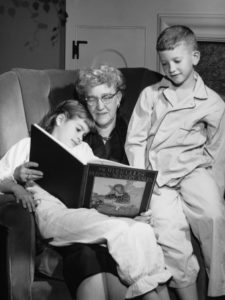 This just in from an Australian study reported in the journal Menopause: Since everyone knows that keeping mentally alert and socially engaged are plus factors in staving off dementia, a team of scientists decided to look at whether or not caring for grandchildren made a difference in the health of post-menopausal women. After all, they reasoned, that caretaking was something that lots of p.m. women do. Why not factor it in?
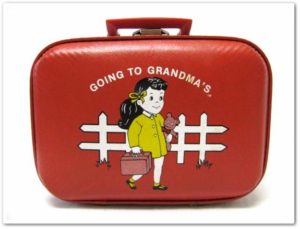 What does it mean that you can buy a t-shirt, a onesie, a tote bag, a bib; even a house decal that announces, “What happens at Grandma’s stays at Grandma’s?”