 As parents, we try so hard not to play favorites. Or, if we do, we do our best to hide our little indiscretions. But even when we are being fair, sometimes our kids will still complain that the other person is getting the piece of cake that has the most frosting, or is somehow getting the bigger slice of the pie.
Oh, you thought this would all go away just because your kids were grown up? You hoped that holiday time would be a pure delight, when old hurts flew away on the wings of little doves?
If the holiday is at your house: Who gets the better room? Who chooses the favorite meal? Or, if you are celebrating at the home of your delightful offspring: Whose house are you going to? How long are you staying? And the spooling out of it all, expressed or implied: Which grandchildren do you really love better?
My mother-in-law, at 98, musters her remaining mental capacities to address the sibling rivalry of her gray-haired children. She insists, as if no one had heard this script before, on doling out equal pieces of the (in her case theoretical) pie.
My friend whose children are only showing the first signs of gray has decided to make her own stand this holiday season. After years of bickering among her offspring about how many nights Grandma spends with each one, she has decided that this year, she will just put her feet up on her own footstool and stay happily at home.
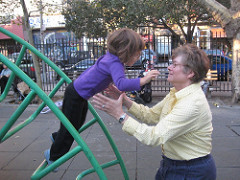 The New York Times recently noticed that, when old folks move to be near their children, that does not necessarily mean frail elders who are themselves in need of care. For the young-old, the lure of being near their kids and grandkids is often coupled with the draw of a fun place to live, or at least to visit a lot. How smart our children are to have settled in someplace that we don’t mind being! What a great excuse to change old habits, even put the old homestead on the market.
 You’ve got to hand it to academics; they have a way of expressing the most basic concept in the most baroque way.
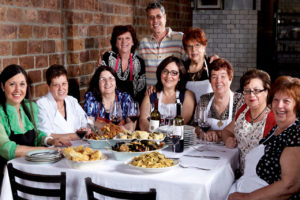 Jody Scaravella grew up in a close-knit Brooklyn-Italian family. When several relatives died within a short period, he felt unmoored. So he moved to Staten Island. Soon, a storefront near the ferry spoke to him. “Restaurant,” it whispered; “Italian family restaurant.”
 This is America, baby! We have parties. We give gifts. We may worry about who is giving what, and who might be offended (diverting attention from the mother-to-be is the most-often heard complaint) but we press on, giving gag presents, outfitting baby’s home-away-from-home, kidding the soon-to-be-grandma about her abilities and her recall.
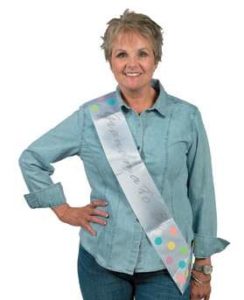 Listen up all you newbie grandmothers: The class will be meeting, and you will be expected to attend.
 nice to have a study from Brigham Young University that lays it all out. For fifth graders who had grandparents living near by, those who were close to them had improved social skills, like kindness and compassion, and were more engaged in school. Grandparents who helped their offspring financially, especially single parent families, were able to make a real difference in their grandchildren’s lives.

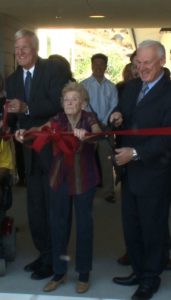 Take a bunch of teenagers with no families, and a bunch of grandparent-age people with extra energy and love. Add sunshine and a lovely campus. Blend.
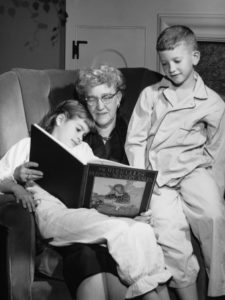 This just in from an Australian study reported in the journal Menopause: Since everyone knows that keeping mentally alert and socially engaged are plus factors in staving off dementia, a team of scientists decided to look at whether or not caring for grandchildren made a difference in the health of post-menopausal women. After all, they reasoned, that caretaking was something that lots of p.m. women do. Why not factor it in?