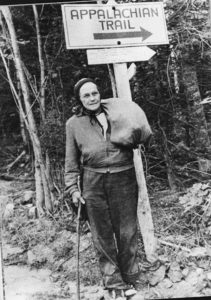
 More than 60 years ago, in 1954, Emma Gatewood, a 66-year-old grandmother, equipped with sneakers, a blanket, and a plastic shower curtain, set out to hike the Appalachian Trail. She was unsuccessful. Her glasses broke, and she was forced to give up.
But the next year she tried again. And succeeded. She was the first woman to hike the 2,050 mile trail that runs from Georgia to Maine. She was also the first woman to hike it twice, and the first woman to hike it three times. (She was 75 on that trip.)
One of 15 children born to a Civil War veteran on an Ohio farm, she went on to marry and have 11 children of her own. She also had a husband who beat her for 30 years, until she found the courage to divorce him.
Gatewood’s conquest of the A.T. garnered a lot of publicity. Grandma Gatewood, as she became known, did not talk about her past. However, she did talk about the poor conditions on the trail. The stories she told, and the repairs that followed, inspired a new generation of hikers.
She also walked 2,000 miles of the Oregon Trail, visited all 50 states, and left 24 grandchildren, 30 great-grandchildren, and one great-great-grandchild when she died at age 85.
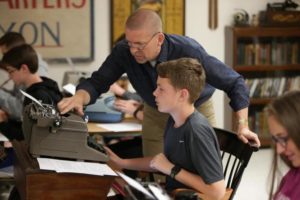 When I visited my grandchildren’s school recently for a fundraising fair, members of the poetry club had set up a booth. They offered to write a poem to your specifications, using — typewriters! First, of course, they had to learn how to use the typewriters.
 If the President is POTUS (president of the United States) and the First Lady is FLOTUS, then the first grandmother is obviously GOTUS. And, in the current administration, she has played a critical role.
 Finding out that your darling baby grandchild is deaf is certainly tough. The parents are most likely in turmoil. You probably are as well, and in addition, your family needs you to be strong, whether or not strong is what you feel.
 At least I didn’t show you the really awful photos of babies with
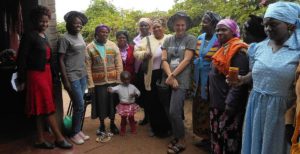 It makes eminent sense: kids in orphanages need hugs, attention, consistency, love. People who have been mothers and grandmothers, and who are often retired, have the time and the skills to make enormous differences in the lives of children.
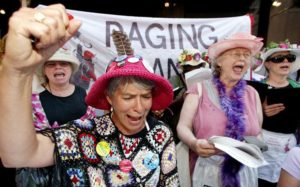 Wouldn’t we all like to be raging grannies, some days? The movement that began in Canada more than 30 years ago has spread to the U.S., the U.K., and beyond. This loosely-knit assortment of social activist specializes in writing songs of protest which they offer up at public events. Their in-your-face dress up gear, as well as their songs, take our old lady stereotypes and fling them them up in the air.
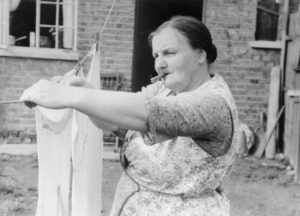 What if grandmothers were the key to a more humane and effective welfare system? That is the premise of a working paper by a British think tank, the Institute of Community Studies.
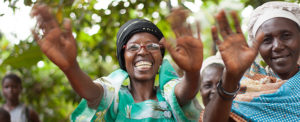 Headlines about the AIDS crisis in Africa have diminished, but orphans who have lost their parents to the disease continue to need care. This is where grandmothers have been essential.